
ThermoSOLV Protein Thermal Stability Kit
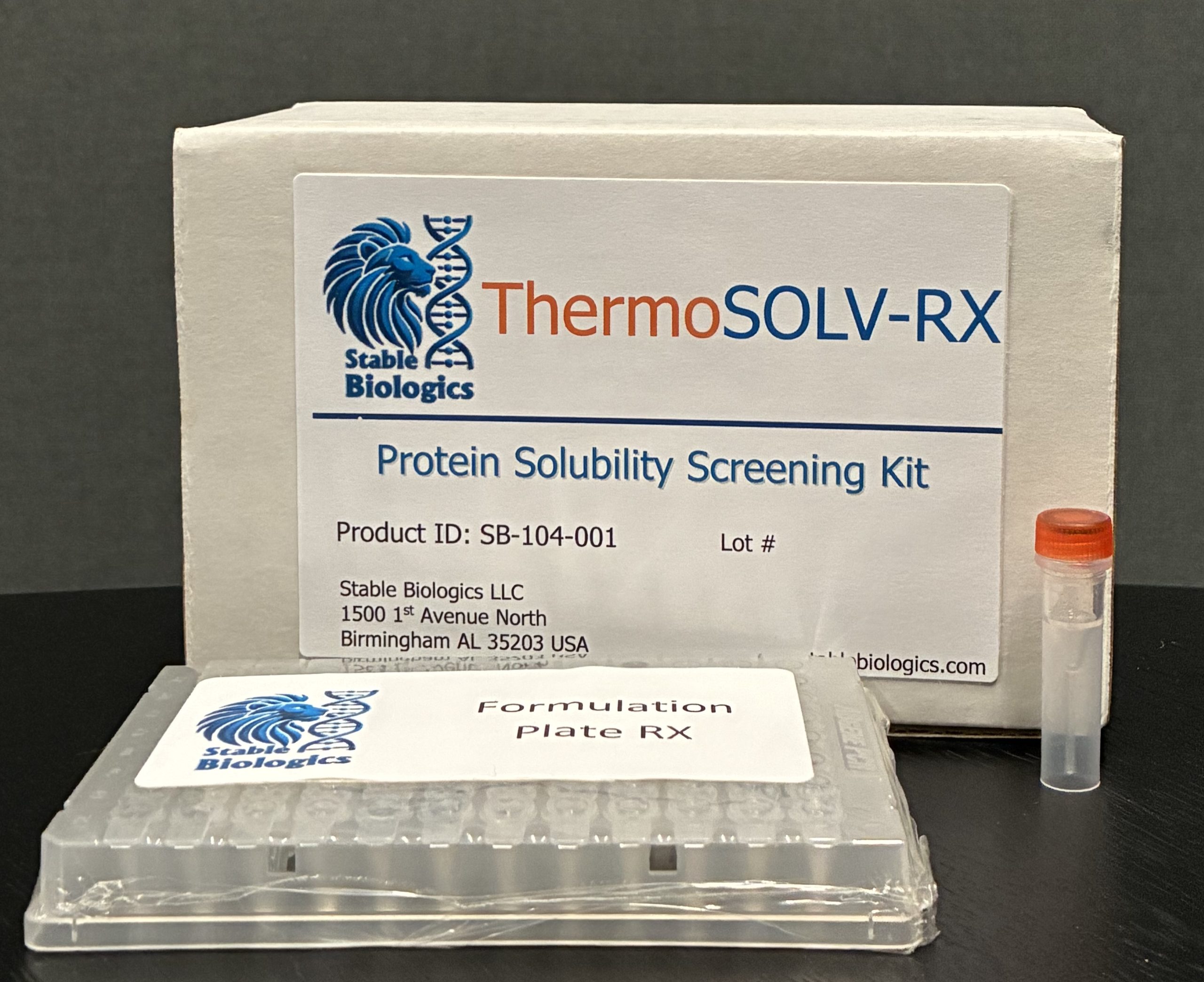
The ThermoSOLV kit offers a systematic solution design and fluorescence-based stability assay for thermal stabilization of protein samples. This kit allows high-throughput screening of 90 different formulations in a 96-well format within few hours. ThermoSOLV kit is available in 2 versions: A) pharmaceutical formulations (-RX) and B) general formulations (-R).
WHY ThermoSOLV?
The ThermoSOLV Thermal Stability Kit is designed to enhance the thermal stability of protein samples. It is best used when stability is a known problem.
Applications include
- Identifying the best buffer, pH, salts and additives for protein production, storage and analysis
- Analyzing effects of protein sequence changes on stability
- Comparing protein batches (quality control)
Some protein samples clump together and aggregate when they expose hydrophobic patches. The target-specific choice of buffer type, pH, salt, organic and additive can reduce this behavior. This ThermoSOLV Protein Thermal Stability Kit helps identifying the solution parameters that provide highest thermal stability.
Technology
ThermoSOLV is a high-throughput formulation screening technology based on a fluorescence thermal shift assay. This assay can be performed in any instrument that detects fluorescence signals with respect to change in temperature, such as q-PCR instruments. The thermogram resulted from the experiment provides denaturation temperature of target protein in formulations.
Data Analysis
Denaturation temperature or melting temperature (Tm) of a protein is determined from the first derivative of the fluorescence vs. temperature curve. Most brands of q-PCR instrument have software that allows such calculations. We have developed a simple graphing software, ThermoPlot, that allows a quick data analysis and Tm determination. Please contact us if you need to access to the ThermoPlot.
FAQ
What is the composition of the ThermoSOLV formulations?
There are two types of ThermoSOLV based on the formulation sets.
ThermoSOLV-RX contains 93 different pharmaceutical formulations in a 96-well format, the remaining 3 wells contain controls. The set is a combination of 10 types of buffers (pH varies from 3 to 8.5) and 13 pharmaceutical excipients (salts, amino acids, sugars, surfactants, preservatives).
ThermoSOLV-R contains 90 different formulations with array of buffers (from pH 3 to pH 10) and a series of solubility enhancers (salts, amino acids, sugars, polyols, reducing agents). ThermoSOLV-R formulation plate contains formulations that are applicable to a wide variety of industries such as pharmaceutical, industrial enzymes, crystallography, etc. Some of the formulations in the ThermoSOLV-R formulation plate are not applicable as pharmaceutical inactive ingredients.
Can I run ThermoSOLV experiment in any q-PCR instruments?
Yes, you can. The ThermoSOLV kit comes with a general User Guide on how to set the experiment. However, each q-PCR instrument has a unique software setting.
How many samples can I process with a ThermoSOLV kit /How many “runs” are in each kit?
The ThermoSOLV kit comes with a formulation plate (-R or -RX plate) and a tube of fluorescent dye. A single kit can typically be used to perform up to 5 separate experiments. The user is typically required to perform sample-dye ratio optimization on the instrument to optimize signal to noise/background ratio.
What is the composition of the ThermoSOLV formulation plate?
There are two types of formulation sets available: RX plate and R plate. Please consult each user guide for list of formulations from each type of plate.
Have a formulation challenge or need analytical support?
We’re ready to collaborate.
Founded in 2008 through an academic research collaboration, we provide high-throughput biologics formulation services backed by proven science. Using advanced self-interaction chromatography (SIC), we rapidly screen protein stability with minimal material, delivering results in weeks—not months. With 30+ commercial projects completed, we offer end-to-end support from protein expression and formulation through analytical testing, stability studies, and Phase I manufacturing.