
VeroSOLV Protein Solubility Kits
VeroSOLV Protein Solubility Kits help researchers to identify formulations that protect target protein from aggregation, or to solubilize an aggregated protein sample. VeroSOLV Protein Solubility Screening Kit contains a systematically varied array of buffers (from pH 3 to pH 10) and a series of solubility enhancers or excipients that enable the determination of conditions under which a particular protein sample is protected from aggregation or can be de-aggregated. A total of 90 different formulations can be tested in one single, label-free experiment; the remaining experiments are positive and negative control experiments.
VeroSOLV kit is available in 2 versions: A) pharmaceutical formulations (-RX) and B) general formulations (-R). VeroSOLV-RX kit is geared towards maintaining the stability of pharmaceutical biomolecules, the VeroSOLV-R kit provides the high-throughput solubilizing power for protein in general such as industrial enzymes, plants and agricultural proteins, etc.
Why VeroSOLV?
VeroSOLV Protein Solubility Screening Kit help researchers in solubilizing and stabilizing their target protein and protect it from aggregation.
- Quickly evaluate aggregation behavior as a function of buffer types, pH, and excipients
- Assay more than 90 different conditions in parallel and label-free
- Simple mix and spin protocol, no ultracentrifugation required
- Opportunity to rescue reversibly aggregated samples
- Protect your biomolecule from aggregation under stress
- Quickly find trends with the Protein QuickPlot
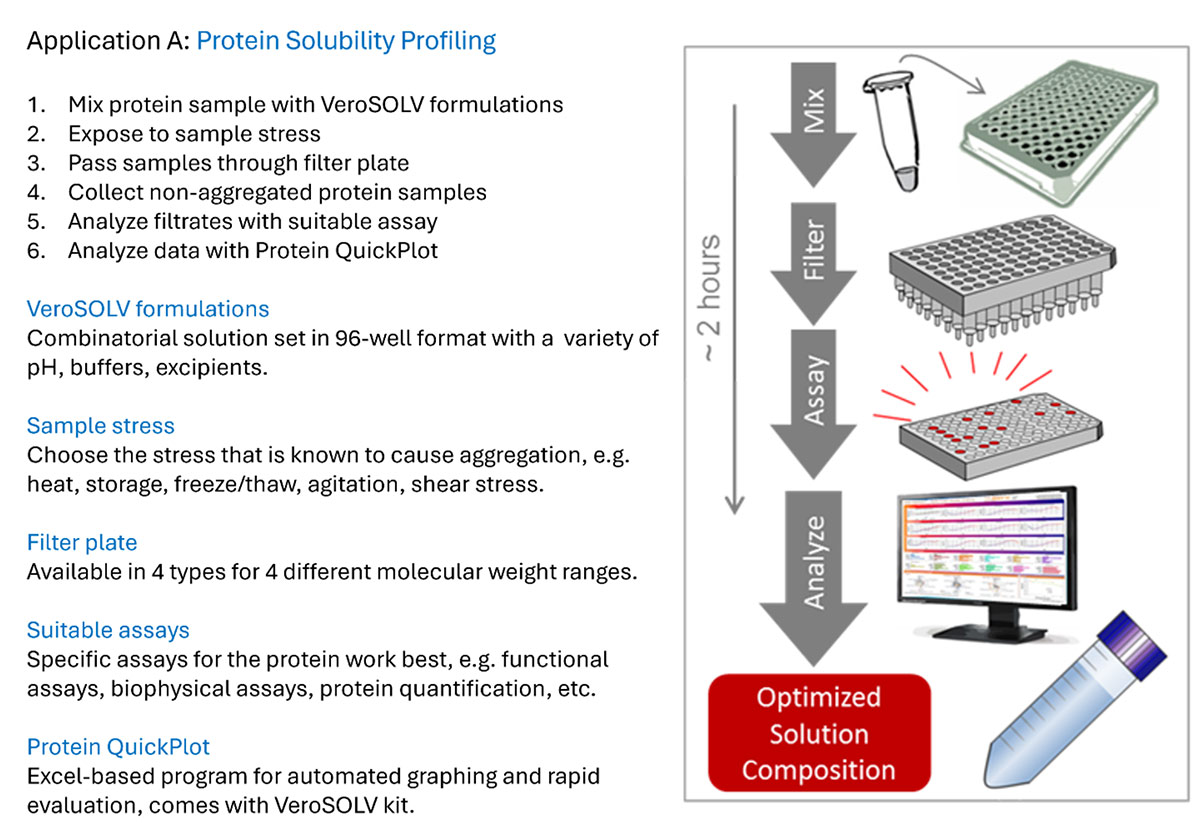
Proteins aggregate. This undesired process is often caused by elevated temperature, vigorous stirring, addition of ligands or molecular binding partners or just by mere storage of a protein sample over a period of time. Protein aggregation can often be avoided with proper choice of pH, salt or stabilizing additives.
Soluble proteins pass filters, aggregated proteins do not. This simple feature is exploited to in the filtration step. The wells that contain soluble proteins will yield protein after the filtration process; those with protein aggregates will not contain any protein. After running the VeroSOLV Kit you have established conditions that keep your biopharmaceutical target in solution and you know conditions at which your protein aggregates.
- Better and faster than a conventional trial-and-error testing
- Low protein consumption consumes about 15 µL for each protein solubility data point. However, the protein quantity should be matched with your method of detection.
- Convenient: Obtain a lot of information on protein solubilization in one experiment. Utilize the target specific assay of your own choice. The VeroSOLV kit is compatible with many functional assays, such as UV/VIS absorbance, fluorescence-based protein detection, BCA assay, etc.
Technology
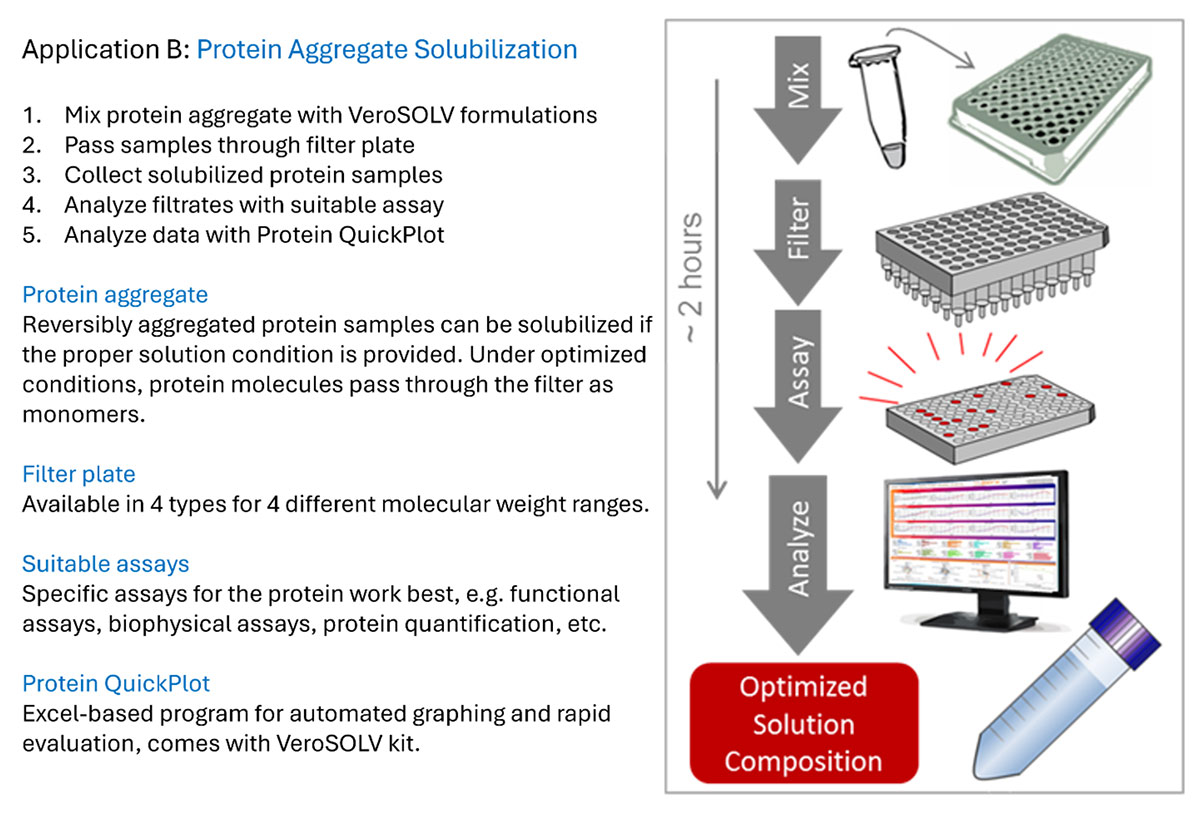
VeroSOLV is a high-throughput screening kit based on filtration technology. A protein in its original buffer condition is mixed separately with various formulations. Protein in formulations that promote solubilization will be detected in the filtrates after passing through a specific molecular weight cut-off filter. On the other hand, aggregated protein due to ‘bad’ formulations is retained on the filter. This combinatorial solution and filtration approach identifies the optimal pH, buffer type, and additives that maintain samples solubilized. One can either solubilize an aggregated protein solution or select a particular sample stress (heat, freeze-thaw, storage, shear etc.) and identify those solutions that keep the protein sample solubilized without aggregation. Data evaluation is supported with Protein QuickPlot. Contact us to obtain the Protein QuickPlot.
Which VeroSOLV do I buy?
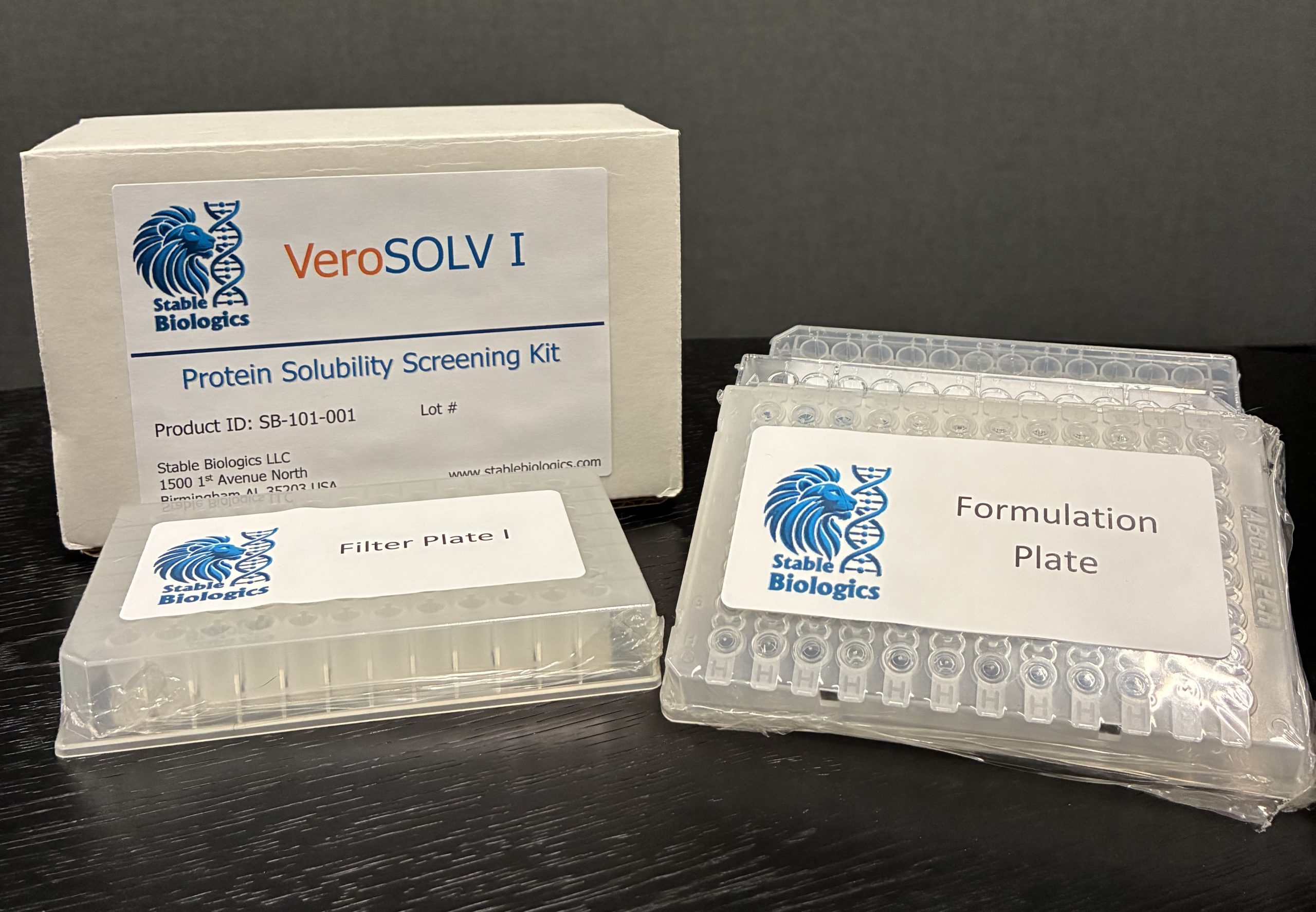
Select the type of formulations: (a) pharmaceutical formulations (VeroSOLV-RX) or (b) general formulations (VeroSOLV-R). VeroSOLV-RX kit is geared towards maintaining the stability of pharmaceutical biomolecules, the VeroSOLV-R kit provides the high-throughput solubilizing power for protein in general such as industrial enzymes, plants and agricultural proteins, etc.
Select the right kit for the molecular weight of your protein.
The VeroSOLV kit is compatible with a wide diversity of protein sizes ranging from several kDa to 250 kDa. Filter plates should be selected according to the expected MW of the solubilized protein molecule.
| Type | Size |
|---|---|
| VeroSOLV I | Peptides, size < 10 kDa |
| VeroSOLV II | Small protein molecules > 10 kDa and < 25 kDa |
| VeroSOLV III | Protein molecules up to 90 kDa |
| VeroSOLV IV | Large protein molecules including antibodies and oligomers up to 250 kDa |
FAQ
Will my aggregated protein sample ‘go in solution’ with the VeroSOLV formulations?
This depends on the nature of the protein aggregate. The only way to find out is by running an experiment, and this is exactly what the VeroSOLV protein solubility screen does. Test 90 different mild formulations – different pH, salts, polymers, sugars, polyols, detergent, reducing agents. If the protein sample is reversibly aggregated, chances are the screen will yield conditions that solubilize the sample.
The goal is to solubilize the aggregate and yield functional protein. Will any aggregated protein samples get solubilized?
No, some aggregates just contain ‘dead’ protein. You will need SDS or urea for such recalcitrant samples, and obtain non-functional protein in return.
How much protein is required to run a VeroSOLV kit?
The protein concentration will be diluted by 11 times (15 µL/165 µL) in the reaction plate when the protein solution is combined with the formulations. One has to start with a stock protein solution that is 11 times the final solution concentration in the reaction plate. Circa 2 mL of protein stock solution is adequate. The required protein concentration depends on the extinction coefficient of the protein and the sensitivity of the protein detection assay. In our laboratory, we developed a UV280 method using half-width UV 96-well plate and UV/vis plate reader. In our case, the UV280 absorbance in half-width UV280 wells has to be at least around 0.4 (absolute absorbance units).
Click here to access the VeroSOLV Manual!
How do I analyze the results of the VeroSOLV experiments?
We advise to select a sensitive protein detection assay to characterize the filtrate, preferentially in 96-well format. In most cases plate reader data can be directly copy-and-pasted into the Protein QuickPlot Spreadsheet to evaluate the results of the experiment and obtain graphical support of protein behavior trends and identify the critical solvent factors for optimal protein solubilization.
Which Protein Assay works well with VeroSOLV?
Various analytical assays may be applied to determine the quantity or activity of protein in the filtered solution. The various assays may be based on detection of fluorescence or radioactivity (protein assay, enzyme assay, western/ELISA, ligand binding assay). Note that assays may require compensation for VeroSOLV formulations or may not work in the presence of the VeroSOLV formulations. Please consult the appropriate assay manual.
Our laboratory has developed a UV280 protocol for analyzing the filtrates from VeroSOLV kit. This is up to the user and depends on what a user wants to screen for. Functional assays (measuring binding or enzymatic activity) or passive assays (measuring protein mass) can both be employed. Several users who have subjected purified protein samples have employed the Pierce BCA assay – and the ‘MICRO’ variant thereof.
How long does the experiment take?
It depends somewhat on the setup, but plan for approximately 3 hours to run the experiment.
How many samples can I process with a VeroSOLV kit / How many “runs” are in each kit?
The VeroSOLV protein solubility screening kit is designed to be run with a single protein sample only. While we have heard from users that have employed the filter plate several times successfully, we do not recommend it. Multiple uses will eventually clog the filter and result in unreliable results.
How does the Protein QuickPlot help in analyzing my data?
You are welcome to use any tool you want to graph and visualize your results. The Protein QuickPlot is a quick way to graph dependencies of pH vs other parameters. It provides an overview and a detailed understanding of protein sample behavior.
What is the composition of the VeroSOLV formulation plate?
There are two types of formulation sets available: RX plate and R plate.
Have a formulation challenge or need analytical support?
We’re ready to collaborate.
Founded in 2008 through an academic research collaboration, we provide high-throughput biologics formulation services backed by proven science. Using advanced self-interaction chromatography (SIC), we rapidly screen protein stability with minimal material, delivering results in weeks—not months. With 30+ commercial projects completed, we offer end-to-end support from protein expression and formulation through analytical testing, stability studies, and Phase I manufacturing.